
 Available in US
Sports Betting Bankroll Management: The Complete System

Professional bankroll management tools and strategies for sports betting success
Most sports bettors who lose money don’t lose because they’re terrible at picking winners. Protect your funds while following daily sports predictions. They lose because they bet too much on individual wagers, chase losses after bad beats, increase stakes during winning streaks, and generally treat their betting capital like it’s infinite rather than the finite resource it actually is. You can be a legitimately skilled handicapper who identifies value better than seventy percent of bettors and still go broke if your bankroll management is garbage.
The mathematics are brutal and unforgiving. If you’re betting ten percent of your bankroll on every wager, you only need a streak of ten consecutive losses to wipe out your account entirely. That sounds unlikely until you realize that even if you’re winning fifty-five percent of your bets at standard odds, losing streaks of ten or more occur regularly over large samples. The bettor who survives these inevitable downswings through conservative stake sizing stays in the game long enough for their edge to manifest. The bettor who overextends doesn’t get that chance.
Bankroll management isn’t sexy. It won’t make you rich quickly. It doesn’t provide the emotional rush of putting your entire account on a “lock” that can’t possibly lose. But it’s the foundational discipline that separates long-term winners from the endless parade of bettors who blow up their accounts and quit, then restart with fresh deposits and blow up again in an expensive cycle that never builds sustainable profitability. Use this financial discipline when checking our reliable betting tips.
This guide builds a complete bankroll management system that works regardless of your betting style, sports preference, or current skill level. The principles apply whether you’re betting football, basketball, tennis, or anything else. They work for favorites, underdogs, totals, props, or any other market. They scale from small recreational bankrolls to serious professional operations. Most importantly, they actually work if you implement them with discipline, which unfortunately is where most bettors fail.
The system isn’t complicated, but it requires emotional control that goes against instinct. You’ll be tempted to deviate after tough losses. You’ll rationalize bigger bets on matches you feel especially confident about. You’ll convince yourself that a hot streak means you should be betting more aggressively. These temptations destroy bankrolls. The bettors who resist them and stick to systematic bankroll management boring their way to profits over months and years are the ones still betting successfully while everyone else has gone broke.
Defining Your Betting Bankroll
The first critical decision in bankroll management is determining what actually constitutes your betting bankroll. This sounds obvious but most bettors get it wrong in ways that create immediate problems. Your betting bankroll is not your checking account balance. It’s not money you need for rent next month. It’s not your emergency fund. It’s capital dedicated specifically to betting that you can afford to lose entirely without affecting your ability to pay bills, buy food, or handle unexpected expenses.
This separation between betting capital and living capital isn’t optional or a suggestion for advanced bettors. It’s an absolute requirement that applies regardless of your experience level or bankroll size. If you’re betting with money you need for essential expenses, you’re not investing in positive expected value opportunities. You’re gambling destructively and creating financial stress that will compound when the inevitable losing streaks arrive.
The amount you dedicate to a betting bankroll depends entirely on your financial situation and risk tolerance. For some bettors, a proper starting bankroll might be two hundred dollars. For others it might be five thousand dollars or twenty thousand dollars. The absolute size matters less than ensuring the capital is genuinely disposable and that losing it completely wouldn’t create hardship.
Many beginning bettors make the mistake of starting with insufficient bankrolls relative to their desired bet sizes. They want to bet twenty dollars per game but only have a two hundred dollar bankroll. The math doesn’t work. Ten percent per bet stakes mean that a modest losing streak destroys the account. The minimum viable bankroll for serious betting depends on your unit size, but generally you want at least one hundred units available. If you’re betting ten dollar units, that means a one thousand dollar bankroll minimum.
The bankroll should be held separately from your personal finances in a dedicated account or payment method. This physical separation reinforces psychological separation and makes tracking betting results much easier. Many bettors use specific e-wallets or prepaid cards exclusively for betting, keeping the capital isolated from normal spending. When your betting account hits zero, you’re done betting until you can add disposable income to rebuild the bankroll. You never pull from savings or bill money to keep betting.
Bankroll growth should be organic, funded by profits rather than by adding money from external sources. The ideal progression starts with a modest initial bankroll, establishes profitability over several months, then adds periodic deposits from your regular income while the bankroll grows through winning bets. Eventually a profitable bettor reaches the point where the bankroll sustains itself through betting returns without requiring additional deposits.
Withdrawals need rules that prevent you from treating your betting account as an ATM that gets constantly drained. Some bettors withdraw profits monthly or quarterly, keeping their bankroll at a stable base amount while taking income from betting. Others let the bankroll grow continuously to increase unit sizes and potential returns. Either approach works if implemented consistently. What doesn’t work is constantly withdrawing whenever the account hits a certain level, which prevents the bankroll from growing and limits your betting potential.
The psychological aspect of bankroll definition matters as much as the practical. You need genuine emotional detachment from your betting capital. Losing bets should feel neutral rather than devastating. This detachment is only possible if the money truly is disposable and if your self-worth isn’t tied to betting results. Bettors who can’t achieve this detachment should probably not be betting at all, or should limit themselves to entertainment-sized stakes where losses don’t trigger emotional responses.
The Unit System Explained
The unit system provides the foundation for systematic stake sizing that protects your bankroll while allowing growth. A unit represents a fixed percentage of your total bankroll, typically between one and five percent depending on your risk tolerance and confidence in your edge. Every bet is sized in units rather than in fixed dollar amounts, which means your actual stakes scale automatically as your bankroll grows or shrinks.
The mathematics behind the unit system ensure you’re never risking too much on individual bets regardless of recent results. If you bet two percent units from a one thousand dollar bankroll, each bet risks twenty dollars. If you hit a losing streak and your bankroll declines to eight hundred dollars, your units automatically shrink to sixteen dollars. This automatic adjustment prevents the catastrophic losses that occur when bettors continue betting the same fixed amounts as their bankroll depletes.
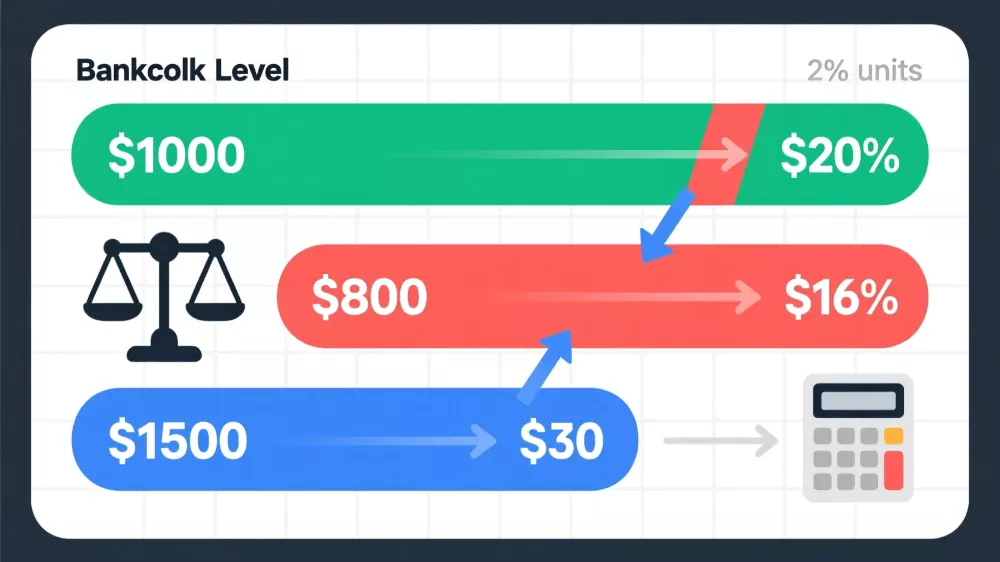
How the unit system automatically adjusts bet sizes based on bankroll changes
Conversely, the unit system captures bankroll growth efficiently. If your bankroll grows to fifteen hundred dollars through profitable betting, your two percent units increase to thirty dollars. You’re betting more when you have more capital available, which accelerates growth during winning periods while the conservative percentage-based sizing protected you during the losing streak that preceded it.
Choosing your unit size requires honest assessment of your risk tolerance and betting skill level. Conservative bettors with lower confidence in their edge might use one percent units, risking only ten dollars from a one thousand dollar bankroll on each bet. This ultra-conservative approach provides maximum protection against variance but limits potential returns. You need a very large number of bets for small edges to compound into meaningful profits at one percent unit sizing.
Moderate bettors typically use two to three percent units, balancing reasonable protection against variance with growth potential. At two percent units, you need fifty consecutive losses to entirely deplete your bankroll, which is extraordinarily unlikely even for losing bettors. Meanwhile, winning at a sustainable five percent ROI generates meaningful bankroll growth over time. This moderate approach suits most bettors with genuine but modest edges.
Aggressive bettors comfortable with higher variance might use four to five percent units. This sizing accelerates growth during winning periods but exposes you to significant drawdown risk during losing streaks. At five percent units, a streak of twenty losses cuts your bankroll in half, which is psychologically devastating even if you have genuine long-term edge. Aggressive sizing only makes sense for highly skilled bettors with well-established track records of profitability who can emotionally handle the increased volatility.
Going beyond five percent per bet ventures into reckless territory where variance overwhelms even legitimate edge. Some bettors convince themselves that betting ten or fifteen percent on “strong plays” is justified by their confidence level. This thinking leads to ruin. No bet is certain, and overconfidence causes more bankroll destruction than any other single factor. Professional bettors with decades of experience rarely bet more than five percent on even their strongest opinions.
The unit system requires periodic recalculation as your bankroll changes. Some bettors recalculate units daily based on current bankroll. Others do it weekly or monthly. Daily recalculation provides the most precise adjustment but creates administrative overhead. Monthly recalculation is easier to manage and captures most of the benefits with less hassle. The key is consistency in whatever schedule you choose rather than recalculating opportunistically to justify larger bets.
Fractional units handle situations where you want to bet less than your standard unit size. If your normal bet is one unit but a particular wager seems valuable yet uncertain, you might bet half a unit or quarter unit. This flexibility lets you express different confidence levels in your opinions while maintaining systematic approach. The inverse betting multiple units on “strong plays” is where most bettors get into trouble, though we’ll address that in advanced sections.
Flat Betting Versus Progressive Systems
The debate between flat betting and progressive staking systems has consumed endless forum discussions and betting strategy debates. Flat betting means wagering the same amount on every bet regardless of recent results. Progressive systems vary stakes based on previous outcomes, increasing bets after wins, after losses, or according to various formulas. For the vast majority of bettors, flat betting wins this debate decisively.
Flat betting works because betting outcomes are essentially random from the bettor’s perspective even when you have genuine edge. Having just won or lost your previous bet provides zero information about whether your next bet will win or lose. The outcomes are independent events driven by the complex interactions of teams, players, variance, and all the factors that determine sporting events. Your recent results don’t change the probability of your next bet being successful.
This independence means that progressive systems predicated on recent results don’t actually improve your expected returns. A Martingale system that doubles stakes after losses doesn’t increase your win probability it just means you’re risking more capital trying to recover from losses. A positive progression that increases stakes after wins doesn’t make future wins more likely it just means you’re betting more at arbitrary times based on recent variance.
The mathematical expectation from flat betting equals the expected value of your bets multiplied by the number of bets made. If you bet one hundred dollars on one hundred bets with three percent edge, your expected profit is three hundred dollars regardless of the order those wins and losses arrive. Progressive systems don’t change this fundamental expected value, they just alter the variance and risk profile.
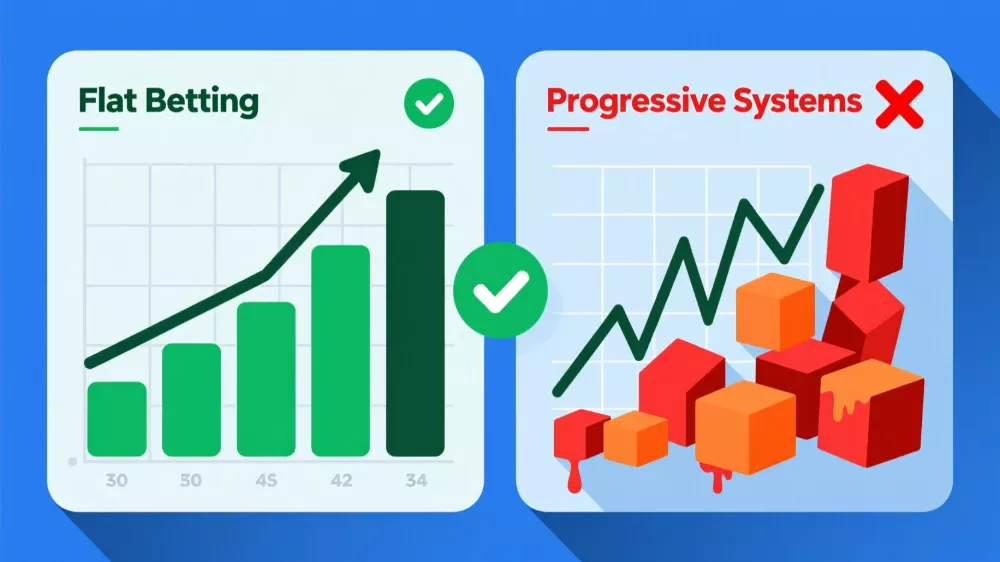
Visual comparison between flat betting consistency and progressive systems volatility
Where progressive systems become actively harmful is in how they interact with bankroll management. Systems that increase stakes after losses, trying to win back previous losses quickly, lead directly to bankruptcy during extended losing streaks. The bettor who doubles stakes after each loss needs only seven or eight consecutive losses before the required bet exceeds their entire remaining bankroll. These losing streaks happen regularly even to skilled bettors.
Systems that increase stakes after wins might seem safer but create different problems. You’re betting more during winning streaks and less during losing streaks, which sounds attractive until you realize that winning and losing streaks are just variance. The next bet after a winning streak is no more or less likely to win than any other bet. You’re simply betting more at arbitrary times, and when the inevitable regression occurs, those larger bets after the winning streak hurt just as much.
The psychological appeal of progressive systems comes from the illusion of control and strategy they provide. It feels strategic to vary your bets according to a system rather than just betting the same amount repeatedly. The system provides rules and structure that make betting feel like you’re implementing sophisticated strategy rather than just gambling. This psychological comfort comes at the cost of increased risk without any increase in expected returns.
Flat betting feels boring precisely because it is boring. You bet the same percentage of bankroll on every wager. When you lose, you accept it and move on to the next bet. When you win, you bank the profit and move on to the next bet. There’s no system to follow, no progression to calculate, no strategy beyond finding value and betting appropriate amounts. This boring approach protects your bankroll during variance while letting edge compound over time.
The exception to flat betting involves varying stakes based on bet quality rather than recent results. If you’ve identified a bet with particularly strong value where your edge is larger than normal, betting slightly more might be justified. Similarly, if a bet seems potentially valuable but you’re less certain, betting less makes sense. This varying of stakes expresses different confidence levels in different bets rather than reacting to recent results.
The danger with confidence-based stake sizing is overconfidence. Most bettors systematically overestimate how certain their opinions are and how large their edge is on particular bets. This leads to betting more on “strong plays” that turn out to be no better than their regular bets, increasing variance without improving returns. Unless you have very well-calibrated estimation of your edge on different bet types through extensive tracking and analysis, flat betting remains the safer approach.
Managing Winning Streaks and Losing Streaks
Winning and losing streaks are inevitable mathematical consequences of betting on probabilistic outcomes. Even a perfectly average bettor with zero edge who breaks even long-term will experience extended runs of wins and losses purely from variance. Sharp bettors with genuine edge will still lose twenty or thirty bets in a row occasionally. Understanding this helps prevent the emotional reactions that destroy bankrolls during both winning and losing periods.
During winning streaks, the primary danger is overconfidence. You’ve won eight bets in a row. The analysis that generated those winners seems obviously correct. You feel like you’ve figured something out and your edge is larger than you realized. The temptation becomes overwhelming to bet more aggressively, to increase unit sizes, to take more marginal bets because you’re “hot” and everything is hitting.
This thinking is completely wrong. Your winning streak is likely just variance. Even if you have genuine skill, the streak itself doesn’t mean your edge is larger than you thought or that future bets are more likely to win. Regression to the mean is inevitable, and when it arrives, the bettor who increased stakes during the winning streak watches profits evaporate much faster than they accumulated.

Maintaining emotional discipline during winning and losing streaks
The correct response to winning streaks is to do absolutely nothing different. Continue betting the same unit sizes. Continue applying the same analytical standards for which bets to place. Continue tracking results and updating your edge estimates based on large sample sizes rather than recent runs. The profits from the winning streak stay in your bankroll, which organically increases your unit sizes through the percentage-based system, but you don’t artificially inflate stakes further.
Many bettors find this discipline nearly impossible. The winning streak feels like validation and momentum. Maintaining flat unit sizing feels like leaving money on the table. But the mathematics are clear increasing bets during winning streaks increases variance without improving expected returns, and the losing streaks that inevitably follow devastate accounts that had been overbetting.
Losing streaks present the opposite psychological challenge but equally dangerous temptations. You’ve lost six bets in a row. Your bankroll is down fifteen percent. You feel like you need to win back those losses quickly. The urge to increase bet sizes, to find “sure things” to bet heavily on, to chase losses becomes intense.
Chasing losses is the single fastest way to blow up a bankroll. The mathematics don’t change because you’ve experienced losses. If your normal bet has three percent expected value, doubling your stake doesn’t double the expected value it just doubles both your potential win and potential loss. If you don’t have edge on these larger bets, you’re just accelerating your losses.
The correct response to losing streaks mirrors the response to winning streaks: do nothing different. Continue betting your normal unit sizes, which have automatically decreased as your bankroll declined. Continue applying your normal analytical process for selecting bets. Continue trusting your system and accepting that variance means losing streaks happen to everyone.
This acceptance requires genuine psychological discipline. You need to believe in your long-term edge enough to ride through the painful short-term variance. If you don’t have that belief, either because you’ve never established that your betting actually is profitable or because you’ve lost confidence in your methods, you shouldn’t be betting at all until you rebuild that foundation.
Stop-loss limits provide a safety mechanism for losing streaks that exceed normal expectations. A stop-loss rule might state that if your bankroll declines by thirty percent from its peak, you take a complete break from betting for at least two weeks. This forces a pause that prevents continued betting while emotionally compromised.
The stop-loss shouldn’t trigger after small declines that represent normal variance. A ten percent bankroll decline happens regularly even to skilled bettors and doesn’t warrant stopping. But a thirty to forty percent decline suggests either extended bad luck requiring a break to reset emotionally, or possibly systematic problems with your betting approach that need analysis before continuing.
Similarly, you might implement stop-loss limits for daily or weekly betting. If you lose three bets in a single day, you’re done betting until tomorrow regardless of other opportunities. This prevents tilt and emotional decision-making from compounding losses during particularly unlucky days.
The key with all these rules is setting them in advance and following them mechanically. Rules created in the moment after losses or wins get shaped by your emotional state and fail to protect you. Rules created during neutral periods and followed rigidly actually work because they override the psychological biases that emerge during streaks.
Advanced Bankroll Techniques
Once you’ve mastered basic flat betting with consistent unit sizing, several advanced techniques can optimize your bankroll management for different situations. These approaches require more sophistication and self-awareness but provide benefits for bettors with established track records and proven edges.
The Kelly Criterion provides a mathematical formula for optimal bet sizing that maximizes long-term bankroll growth. The formula calculates exactly what percentage of your bankroll to bet based on your edge and the odds you’re receiving. The calculation is: edge divided by odds, where edge equals your win probability minus the implied probability from odds.
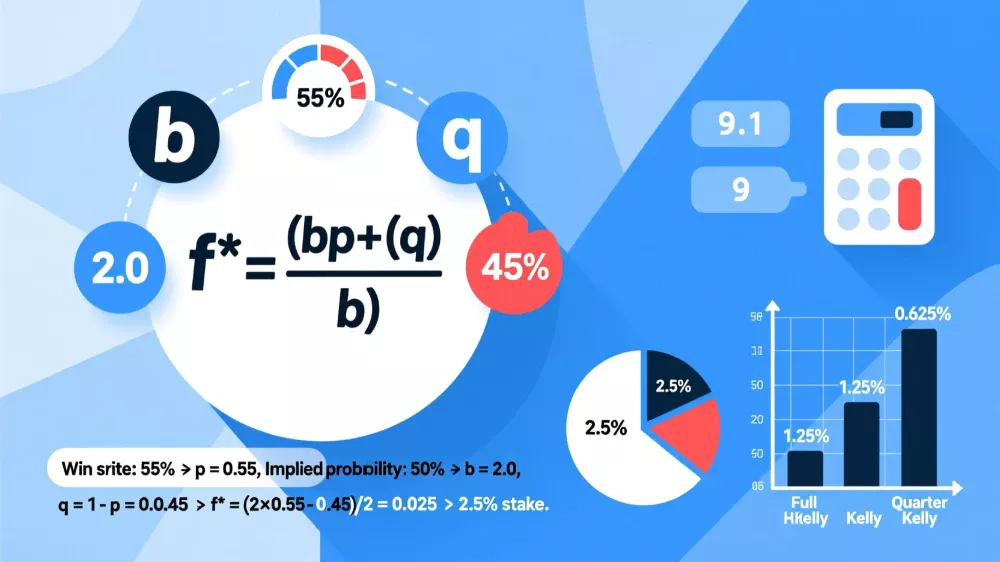
Understanding the Kelly Criterion formula for optimal bet sizing
For example, if you estimate a fifty-five percent win probability on a bet with even odds (fifty percent implied probability), your edge is five percent. Dividing by the decimal odds of 2.0 gives Kelly stake of 2.5 percent of bankroll. The Kelly Criterion says this percentage maximizes your long-term growth rate while minimizing risk of ruin.
The challenge with Kelly betting is that it requires extremely accurate probability estimates. If you overestimate your edge even slightly, Kelly sizing becomes too aggressive and increases variance substantially. Most bettors systematically overestimate their edge on individual bets, which means full Kelly betting often leads to excessive volatility and drawdowns.
Fractional Kelly solves this problem by betting some fraction of the full Kelly stake, typically one-half or one-quarter Kelly. This approach captures most of the growth benefits while significantly reducing variance. Half Kelly betting means calculating the full Kelly percentage and then betting only half that amount. For our earlier example with 2.5 percent full Kelly, you’d bet 1.25 percent half Kelly.
Most professional bettors who use Kelly betting actually use fractional Kelly for this reason. The reduced variance makes the approach more psychologically sustainable and protects against overconfident edge estimates. Quarter Kelly is particularly conservative and works well for bettors who know they have edge but aren’t confident in precisely sizing that edge for individual bets.
Multiple bankrolls provide another advanced technique for bettors with substantial capital and different betting focuses. You might maintain separate bankrolls for different sports, different bet types, or different risk levels. Each bankroll operates independently with its own unit sizing and tracking.
This aggressive approach only makes sense for specific situations. A bettor with strong income from employment who can easily reload their bankroll after a bust might rationally choose aggressive growth strategies because the downside is limited. A bettor with no backup funding who needs their bankroll to sustain their betting should never use aggressive strategies because variance will eventually destroy them.
Professional bankroll strategies involve additional complexity around tax planning, multiple sportsbook accounts, withdrawal timing, and income planning that casual bettors don’t face. These considerations fall outside basic bankroll management but become relevant as betting becomes more serious.
Record Keeping and Analysis
Bankroll management requires comprehensive record-keeping that tracks every bet and provides data for analyzing your actual performance. Most bettors maintain terrible records or no records at all, which prevents them from understanding whether their betting is actually profitable and where their strengths and weaknesses lie.
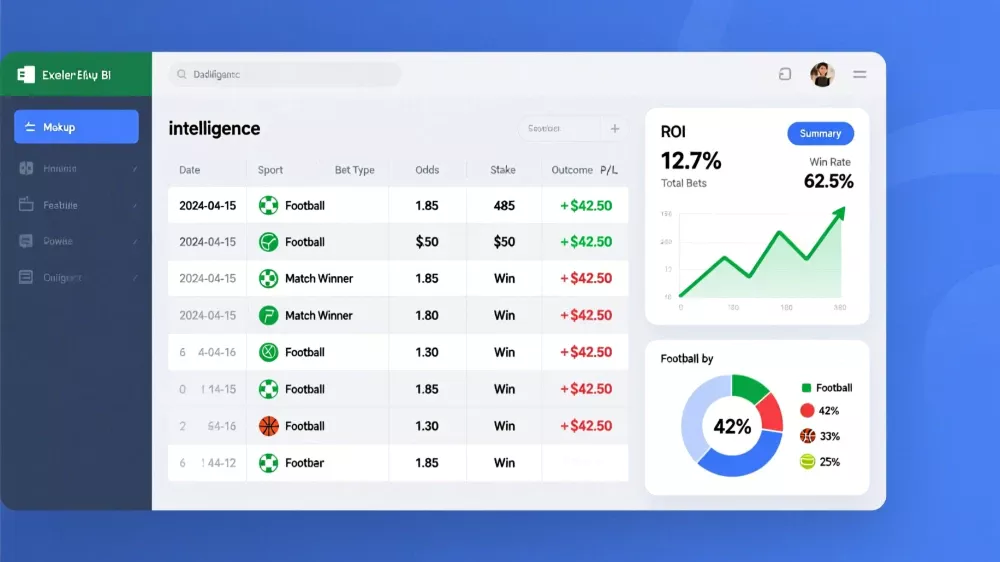
Comprehensive betting tracking system for performance analysis and improvement
Every single bet needs documentation including date, sport, bet type, teams or event, selection, odds, stake amount, outcome, and profit or loss. This data capture happens immediately when you place each bet, not retroactively when you’re trying to reconstruct your betting history from memory or incomplete records.
The tracking needs to capture current bankroll level so you can verify that your calculated unit sizes match your actual available capital. Many bettors lose track of their exact bankroll, estimating it roughly rather than knowing precisely. This sloppiness leads to errors in stake sizing and prevents accurate calculation of return on investment.
Monthly performance reviews analyze your tracking data to identify patterns. Calculate your overall ROI for the month, broken down by sport, bet type, favorite versus underdog, home versus away, and any other relevant categories. Look for areas where you’re consistently profitable versus areas losing money.
These analyses reveal where your analytical approach finds genuine edge and where you’re betting based on overconfidence or bad habits. If you’re profitable on totals betting but losing on match results, that suggests specializing more heavily in totals while reducing or eliminating result bets. If you make money on favorites but lose on underdogs, that pattern informs future bet selection.
The analysis also identifies mistakes in your betting process. Maybe you notice that bets placed on match days without proper advance analysis perform worse than bets placed days earlier after thorough research. Maybe bets on your favorite team consistently lose. Maybe bets over certain odds ranges show systematic problems. These patterns only emerge from comprehensive tracking and analysis.
This comprehensive tracking and analysis feels like overhead that cuts into time available for finding bets and doing analysis. But it’s actually the foundation that makes everything else worthwhile. Without knowing whether your betting is profitable and where your edge comes from, you’re flying blind and likely losing money without realizing it until your bankroll disappears.
